
The Contractor State
The depths of neoliberalism’s waste, inefficiency, bureaucracy and fraud.

“I think what’s been frustrating is that we’ve allowed the language around bureaucracy, efficiency, waste to be seen as if it is a right-wing concern. It is the most paramount left-wing concern, because it is either the fulfillment or the betrayal of that which motivates so much of our politics.”
—Zohran Mamdani
The year was 1966 and Ross Perot saw a once in a lifetime opportunity for profit. The year prior had seen the Johnson administration create Medicare and Medicaid, a set of social programs that would mark a transformative expansion of the welfare state and grant public health insurance to elderly, disabled and low income Americans. It was one of the left’s greatest achievements of its explosive mid-60s breakthrough. Now all the U.S. government had to do was, well, actually give people the healthcare they had secured. This of course required a lot of administrative and bureaucratic work, much of it well suited for the nascent technology of computing, and in a system that still persists today, this work of administration was delegated to state governments to implement on their own terms with the help of nonprofit Blue Cross and Blue Shield associations.
Enter Ross Perot. He was in his mid thirties and had very much lived the life of a cult hero without the cult. He’d tried college, the navy and IBM but none had suited his heterodox ethos and inexorably entrepreneurial spirit, so he started his own information technology company to build in his distinct image, Electronic Data Systems. In an era where computers were an expensive, highly complex technology that required specialized knowledge to use, Electronic Data Systems, or EDS, carved out a niche as a sort of outsourced IT department for corporations, serving such clients as Frito-Lay. But profit margins were thin, and progress was slow. Perot even had to take a second job with the organization EDS happened to share a building with: Texas Blue Cross and Blue Shield.
It was a grotesque, obvious conflict of interest and one that paid extraordinary dividends for the eccentric CEO, who instantly got a contract from Texas Blue Cross and Blue Shield to speed up the processing of Medicare claims with computers, with no negotiations or competitive bidding taking place. Perot wouldn’t even open his books for federal auditors when they got somewhat peeved by this backroom deal. After EDS got another contract in 1968–one that also funded the development of a new claims processing software program for them to develop—federal bureaucrats did more digging, and uncovered that EDS was double-counting Medicare claims, charging Blue Shield by 200% margins. None of this transparent exploitation slowed EDS down. By 1971 they had raked in 36 million and commanded a near monopoly over Medicare subcontracting, scooping up the likes of California Blue Shield with the permission of Governor Ronald Reagan. According to John Ganz’s When The Clock Broke, the Nixon administration tolerated this arrangement in exchange for political favors, namely Perot’s vocal support for the Vietnam War and fundraising for Nixon’s reelection campaign. It was only just the beginning for The Contractor State.
I’ve become equal parts fascinated and incensed with stories like this, especially the context of Zohran Mamdani’s victory massively accelerating interest in the wonky underworld of municipal governance. In fact, weeks ago my new pet fixation was the source of one of my most viral ever tweets, in which I outlined the situation at hand and dubbed it The Contractor State. Since then this phrase and this still desperately underreported (despite heroic efforts from Zohran, Leigh Phillips, Luke Farrell and many others) story of the last 50 years has been stewing in the back of my mind, and I believe it deserves a long form explanation from yours truly. Because wastefulness and deceit from government contractors has gone from an infraction serious enough to garner federal investigations to mundane, run of the mill corruption that gets imposed on Americans with the expectation that we accept it without complaint. I’ve already talked about woeful inefficiency of private contractors and passionately argued for a commitment to public sector efficiency on this Substack before, including in my last article, but this will be a comprehensive treatise.
Throughout the now all too familiar neoliberal turn of the late 20th century, Perot’s business model proved to be an enticing ideological soulmate. It not only suited neoliberalism’s hostility towards the public sector and admiration of the private sector, but offered neoliberalism a unique opportunity to effectively replace the public sector with the supposedly much more efficient private sector, and in doing so, make the state subordinate to capital. Outsourcing government functions to private contractors isn’t exactly privatizing public services or shrinking the size of the state, it’s privatizing the state itself, constructing a private bureaucracy in place of a public one that manages public services for a profit. It’s an arrangement also well suited to the actual aspirations of capital, whose outward ideological stance of anti-statism has always been superseded by their desire for a state to subsidize it, protect it, and manage its affairs. Perot never opposed the welfare state, how could he? He depended on it for profit!
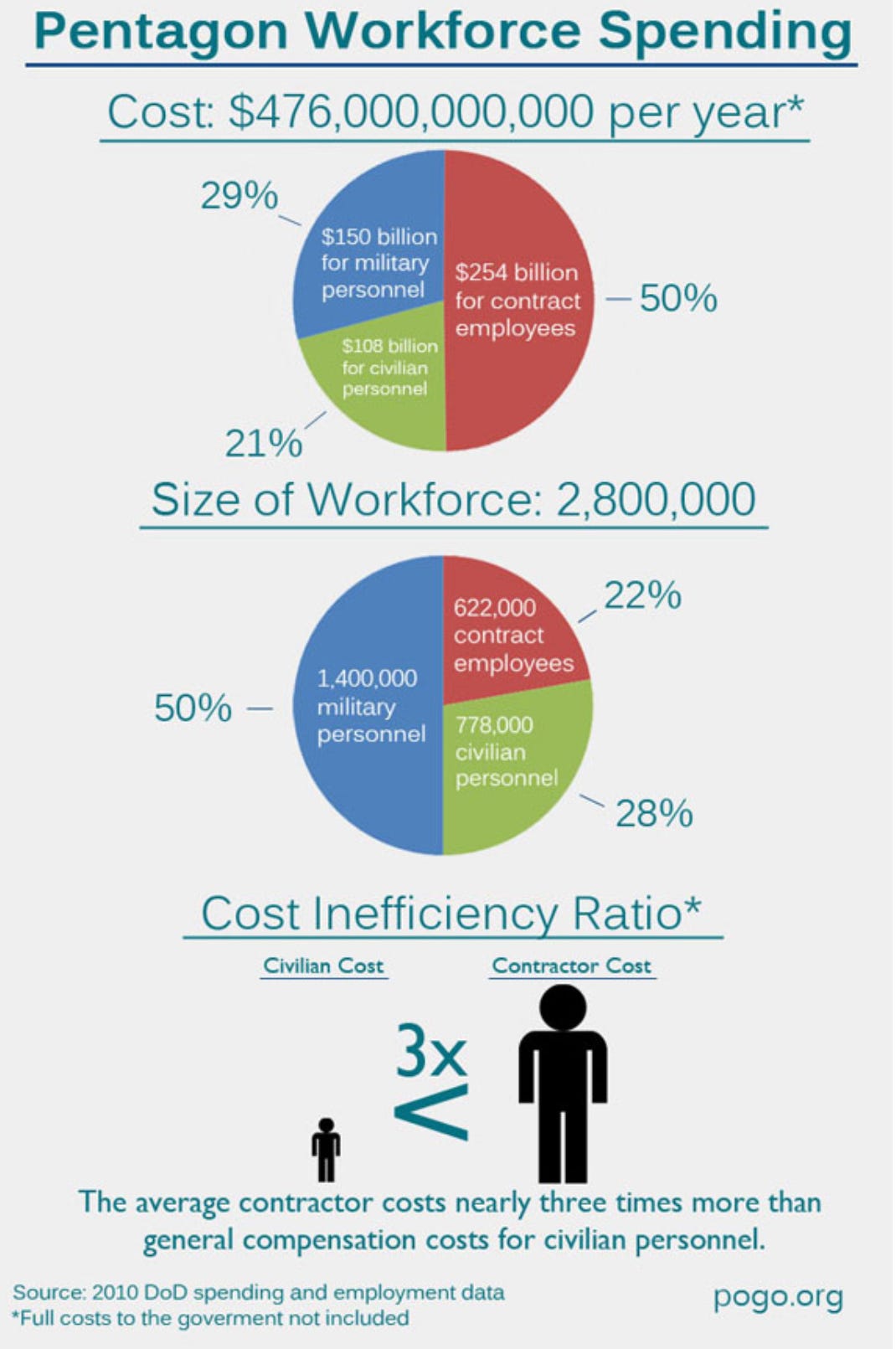
It’s hard to describe the sheer scale at which The Contractor State has grown with appropriate gusto. Successive presidential administrations, from Reagan to Clinton to Bush to Trump have enthusiastically expanded the privatization of bureaucracy, sometimes in the name of gutting public services, like Elon Musk’s staggeringly wasteful DOGE project, but very often in the name of efficiency, the vision of “Reinventing Government,” in the words of Bill Clinton. According to the politically moderate Brookings Institute, there are now two private contractors for every federal employee, with their count being estimated well into the millions. A 2023 study by Paul Light, also of the Brookings Institute, described the situation as the “largest true size of government in American history.” Pretty astonishing after 40 years of neoliberal hegemony! If these estimates sound vague to you, that’s because even though we know precisely how many public sector federal workers there are, we can’t adequately measure the amount of private contractors because we don’t employ enough federal contract managers to investigate such a question. This situation of course compounds the broader issues with private contractors by removing transparency and research into who’s earning their keep and who isn’t.
Even this sweeping overview of this trillion dollar industry sells The Contractor State short in the scope of its reaches, as it’s embedded itself into state and local governments to an equally large extent. Usually this is also done as an expression of neoliberal ideology, but for the sake of ideological humility, I’m gonna talk about a usually local form of The Contractor State that has been embraced by many on the left: Nonprofits. There are some progressives, especially on the Warrenite/NGO left, who’ve been too timid to fully embrace the muscle of the welfare state to solve social problems and have championed the virtues of nonprofits instead. Nonprofits at least lack the profit motive and monopoly power imposed by corporations, and can do very meaningful work, but they’re still often unaccountable, limited in the scope of what they can do and sometimes incompetent. Nonprofits as of late have had issues with waste and corruption everywhere from New York City to Philadelphia to San Francisco. The Minnesota welfare fraud scandal that prompted nothing short of a federal invasion of Minneapolis was caused by the corrupt machinations of an NGO middleman, Feeding Our Future.
With this extraordinary investment and extraordinary trust being placed on the shoulders of private contractors, you would hope that this system of private bureaucracy would be procedurally efficient, deft and free of corruption, but you would be erroneous in that assumption. The most famous study ever done on the efficiency of private contractors found that they were more expensive than federal employees in 33 out of 35 jobs measured. A 2019 study by In The Public Interest, a nonprofit that studies the effects of privatization, found that insourcing privatized government functions—not the other way around—leads to better services at lower prices, from New York City to Sandy Springs, Georgia. There’s a slew of case studies backing this up, from Equifax’s preposterous overcharging of taxpayers to verify work requirements, to Raytheon’s near billion dollar fraud, to everything that’s been going on with Boeing these days. Even the libertarian Cato Institute and the fanatically libertarian Mises Institute have bemoaned the inefficiency and dearth of transparency within The Contractor State.
These failures have stemmed from a variety of causes, with the most obvious problems being cost, transparency and profit. Private contractors simply cost a lot of money. The aforementioned 33 out of 35 study showed that private contractors get paid up to 5 times as much as their public sector counterparts—so even if they were maximally efficient, they’d already be starting off at a disadvantage in terms of efficiency. There’s also the omnipresent profit motive. While the public sector merely needs to provide services, private contractors must generate profit for their own survival, which leads to much of the overcharging and exploitation I’ve discussed and will continue to discuss. There’s also, again, a lack of transparency with private contractors that can easily incentivize lying and corruption. Then there’s the issue of monopoly. The reason why Equifax, for instance, is able to massively overcharge the federal government is that they control nearly the entire electronic verification services industry, making it difficult for competitive bidding to take place.
The really subtle problem, though, is that of coordination. As opposed to centralized state functions which operate under a single entity, outsourcing and privatization creates a decentralized model, a “blended workforce,” in which the public sector is effectively co-governing with various private entities. Neoliberals and even left-libertarians tend to talk about decentralization in glowing terms, but it’s proven to be The Contractor State’s Achilles heel, and not just because it exacerbates the transparency issue. By siloing governance and decision making processes, there’s simply a communication and procedural disconnect that emerges between different actors that slows down and confuses the deliverance of services. The infamous Obamacare website fiasco, for example, was accelerated by the convoluted arrangement of having 55 different contractors coordinating on a single project being operated by a highly questionable private contracting behemoth, CGI Federal. No wonder it was such a mess! If I had to work with 55 other writers and a corporate boss to write this article, it would probably be terrible.
The right still likes to complain about rising government spending and blame it on the perceived largesse of bureaucracy and civil service in order to justify plutocratic scams like DOGE. This perspective is not only misguided but almost touchingly quaint in its outdated understanding of American governance. The neoliberal era championed by those libertarian ideologues has itself created a largesse of government spending on federal labor, but on private contractors rather than public sector employees. No doubt about it, government spending on federal labor has risen astronomically considerably in recent decades—but not on public sector bureaucracy! The size of America’s federal civilian workforce has remained virtually stagnant at roughly 2.3 million individuals (a number that is now dwindling post DOGE) since the 1960s despite the fact that America has become dramatically more populous in that time, and federal worker pay trailed that of their private sector counterparts by an estimated 27.54% even pre DOGE. Right-wing ideologues and confused median voters alike so intrinsically associate the concept of “bureaucracy” with the concept of “government” that they can’t or won’t see the capitalistic nature of today’s bureaucratic waste and the depths of its inefficiency.
As The Contractor State expanded and its ideological mooring grew in status, its reach began to grow from mere administration of government bureaucracy to the creation of more administration, bureaucracy and complexity purely to enrich private contractors. Neoliberalism fostered the rise of means testing, the act of adding extra layers of bureaucracy to the welfare state for the stated purpose of weeding out recipients who “abuse the system.” There’s generally an understanding at this point amongst most smart people that means testing welfare programs is bad and bureaucratic and ends up taking away social services from those who really need them. This perspective is entirely accurate yet still painfully naive. The stealth purpose of means testing is to transfer wealth from poor and vulnerable members of society to private contractors who do the means testing. Means testing is not merely a policy, it’s a business, an industry that demands to be fed. It’s not about efficiency and small government or saving the taxpayer money or encouraging individualistic bootstrapping, it’s a coordinated scheme to enrich a cabal of predatory corporations at the expense of our most vulnerable citizens.
Private means testing bureaucracies not only exploit policies designed for stated purpose of efficiency and fiscal judiciousness, they maliciously revel in conning the taxpayer and doling out hardship to the needy. Repeated audits and investigations have found that the welfare state’s private adjudicators knowingly build byzantine, error prone systems in order to bilk the taxpayer to the furthest possible extremity. No matter where you live in America, you’re always at risk of losing access to Medicaid simply because of a data error. A recent investigation found that 500,000 children had lost access to Medicaid for no reason other than intentionally inept processing systems. In Britain during the pandemic—a seismic event that laid bare the ineptitude of The Contractor State as much as any other—an audit found that their National Health Service was squandering billions on a Deloitte dominated private health bureaucracy that did nothing but serve as a middleman between manufacturers and state services. None of this is remotely necessary. America and Britain are highly advanced economies that can afford to build their own welfare state administration, or, you know, have universal social programs free of privatization and these labyrinthine regulatory procedures.
The intensity with which my fixation on The Contractor State has bloomed has been dramatically hastened by the fact that its might and tyranny is reaching a fever pitch under this administration, with increased powers and abuses whose consequences are only set to escalate in the coming years. Extravagant private contractors have been at the forefront of Trump’s greatest abuses and the beneficiaries of some of his greatest scams. They’ve played a central role in the tyranny and state violence imposed by ICE, with the likes of private prison companies, bounty hunters and even AI companies reaping in hundreds of millions on the backs of the fascist police state. The Big Beautiful Bill seeks to bring Georgia’s work requirement model—which has been a miserable failure—to every state in the country, with billions more going to Equifax. Only 10 months (as of this writing) after the BBB’s implementation of work requirements, SNAP participation has already fallen by 8%, despite a flat unemployment rate.
As has already been alluded to, the perils of The Contractor State very much aren’t limited to domestic policy—military and defense contractors constitute an outright majority of our investment private contractors, and their role absolutely exploded during the War on Terror. Private contractors genuinely outnumbered uniformed soldiers and were enmeshed in every element of conflict, from the actual fighting to logistical support to the doomed nation building crusades that took place in its wake. While I certainly can’t use the words waste and fraud to describe the nearly 10,000 contracted soldiers who lost their lives in those ruinous wars, I can use them to describe the sheer scale of the corruption and ineptitude that took place under the stewardship of these private contractors. In 2019 the Washington Post released The Afghanistan Papers, a vast series of interviews detailing the extraordinary failure of our 20 year nation building project in Afghanistan, failures that are obviously far from limited to private contractors, but which heavily featured such entities in these findings. To pick out just one factoid from this unbelievablely damning report, roughly 40% of taxpayer money spent on contractors wound up in the hands of insurgents, criminal syndicates or corrupt officials.
In the story a central irony emerges: Neoliberalism was supposed to be highly efficient and unbureaucratic. Neoliberalism rhetorically excoriated the extravagant bureaucracies present in communist states and other statist regimes, and yet in practice neoliberalism has imposed some of thickest red tape and wasteful procedural excess one could possibly imagine, from endless complex eligibility rules for social programs to endlessly wasteful contracting practices to adhere to said eligibility rules, to the likes of standardized tests and elaborate performance review metrics. This observation was eloquently expounded upon by Mark Fisher in his post-2008 classic text Capitalist Realism, with a neologism of his own, Market Stalinism. Instead of seeking and measuring actual success, Fisher opines, neoliberal capitalism has instead sought and measured arbitrary and performative representations of performance—like a student’s good score on a standardized test standing in place of actual learning in how we evaluate educational achievement. It’s an intriguing pattern that deserves introspection, and one that proves, if nothing else, that leftists should be deeply concerned with efficiency, specifically public sector efficiency, and strive to reclaim this important concept from the political right.
This battering ram of privatization, waste and corruption has had a devastating effect on American state capacity—and that of the many other countries who have adopted The Contractor State (even this probably too long article leaves much out). There are vast consequences for spending enormous amounts of money on a privatized bureaucracy to get worse public services, both material and political. Vulnerable Americans lose access to services they need, bureaucratic waste is piled up, wars are lost, taxpayer money is squandered. And perhaps even more so than that, relentless state failure to solve basic problems and provide competent services undermines the legitimacy of democracy and obliterates social trust. By failing to build an efficient, responsive public sector that gives taxpayers an excellent return on their investment, you downsize the aspiration of democracy from that of social improvement to harm reductionism, and by doing so lower the expectations of citizens in what they can get out of government and democracy. Perhaps this is the true aim of neoliberalism, an ideology that views the state itself as an existential threat to human flourishing, but for the rest of us who don’t see the world that way, it shouldn’t be our aspiration.
We ultimately need an ideological and electoral project to defeat The Contractor State, one that not only seeks to strengthen public services and rebuild state capacity, but one that discusses this extremely complicated phenomenon openly and condemns it out loud. While DOGE style gutting of the public sector proved to be prohibitively unpopular, American voters do very much believe that there is large amounts of waste and fraud in government operations, and as this article hopes to prove, they are—broadly speaking—correct. As I’ve also explored on this Substack, voters are also far more willing to embrace statist solutions to most problems than commonly assumed. Ever since Zohran’s explosion into the epicenter American political discourse, he’s used his extraordinary rhetorical capabilities to elevate this highly wonky and esoteric issue to greater salience than ever before. The video of his that spawned my viral tweet I mentioned at the very beginning of this article was made to announce audits of city departments, as well as the canceling of the city’s contracts with McKinsey, who disastrously bungled their project to fix Rikers, among other things. He’s promised to audit every citywide department for waste and fraud and bring more services into the purview of the public sector.
I can only hope that Zohran’s woke DOGE experiment proves as effective and influential as I truly believe it will, as we ponder the depths of a new era of leftist governance.